Property Types
Extending an End-of-Terrace: Side & Rear Options
End-of-terrace homes have one huge advantage over mid-terrace: side access. Here is how to make the most of that extra wall for extensions, side returns, and even two-storey additions.
8 min read20 February 2026
The side-access advantage
An end-of-terrace has one exposed side wall — and that wall is your biggest opportunity. Mid-terrace homeowners can only extend to the rear; you can extend to the side as well, potentially adding 50–100% more floor area than a rear-only extension. The side access also means easier construction: builders can bring materials in from the side without going through the house, scaffolding goes up on the exposed wall without needing neighbour access, and there is only one party wall agreement (with the attached neighbour) instead of two. In Dorset, end-of-terrace properties in areas like Boscombe, Winton, and Parkstone were often built on slightly wider plots than mid-terrace, giving even more room for a side extension.
Single-storey side extensions
A single-storey side extension under Permitted Development must not extend beyond the front wall of the original house, must not be wider than half the original house, and must not exceed 4m in height. On a typical end-of-terrace with a 2m side passage, this creates a useful addition — wide enough for a utility room, WC, or to extend the kitchen by 2m. The extension must also be set back at least 1m from the front of the house if it faces a highway, and the materials should match the existing. Cost: £18,000–£30,000. The most effective use is often to combine a side extension with a rear extension in an L-shape — the side element handles utility and WC, the rear element opens up the kitchen-diner.
Two-storey side extensions
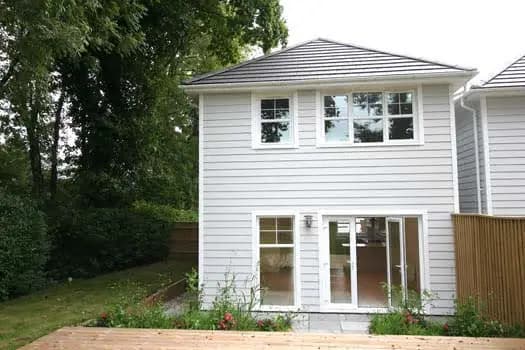
A two-storey side extension transforms an end-of-terrace from a two-bedroom to a three or four-bedroom home. Under Permitted Development, a two-storey side extension must be set back at least 1m from the front elevation, must not be closer than 2m to the side boundary at the upper floor, and must match the existing roof pitch and materials. In practice, most two-storey side extensions on terraces require planning permission because meeting all the PD conditions is difficult. Cost: £45,000–£75,000 for a 3m x 5m two-storey addition with a bedroom and bathroom upstairs and a kitchen extension or utility below. The design challenge is making the extension look like it belongs — a well-designed two-storey side extension should look like the house was always that shape.
Combining side and rear extensions
The wraparound or L-shaped extension is the optimal configuration for an end-of-terrace. Extend to the side and rear simultaneously, creating a single large ground-floor space. A 2m side extension combined with a 3m rear extension adds roughly 25–30m² to the ground floor — enough for a spacious kitchen-diner with utility and WC. The roof design at the junction is critical: an internal valley gutter where the side and rear roofs meet needs careful detailing to prevent leaks. A flat roof over the side element with a pitched roof on the rear (or vice versa) is a common and effective solution. Cost for a combined side-and-rear single-storey extension: £40,000–£60,000.
Written by the PlanBuild team
9 years designing extensions and renovations in Poole, Dorset.
Ready to take the next step?
Related articles
How Much Does a Single-Storey Extension Cost in 2026?
A realistic breakdown of what a single-storey extension costs in Dorset — from foundations to finishing touches, including the costs nobody tells you about.
Read articleOpen-Plan Kitchen Design: 5 Layouts That Actually Work
Not all open-plan kitchens work in practice. Here are 5 layouts we have designed that balance cooking, living, and dining — without the compromise.
Read articleExtending a Victorian Terrace: Side Returns, Loft Conversions & More
Victorian terraces are the most common house type in Britain and among the most rewarding to extend. A guide to the best options — side returns, rear extensions, and loft conversions.
Read articleReady to start your project?
Start with a free project review. No obligation — we call to check the service fits.
Every plan drawn in Poole, Dorset
Serving homeowners across Poole, Bournemouth, Christchurch, Wimborne, Wareham, and the wider Dorset area.